
Editor's note: This timeline first appeared on Feb. 28, 2020, was updated on March 26, 2020, and covers events up to March 1, 2020. It was revised in October 2026 to correct errors and add sources.
Originally published Feb. 28, 2020. Updated March 26, 2020.
What started as a single blockade by the Wet’suwet’en people in British Columbia has become a nation-wide blockade of critical infrastructure.
The story begins in late 2019 when Coastal GasLink (CGL) began to excavate the approved route for its natural gas pipeline from the Montney Formation, outside Dawson Creek, to the Kitimat gas terminal on the B.C. coast. Over the previous four years, CGL negotiated and signed resource and land access agreements with the property owners along the route of its natural gas pipeline, including the Indigenous groups with land claims.
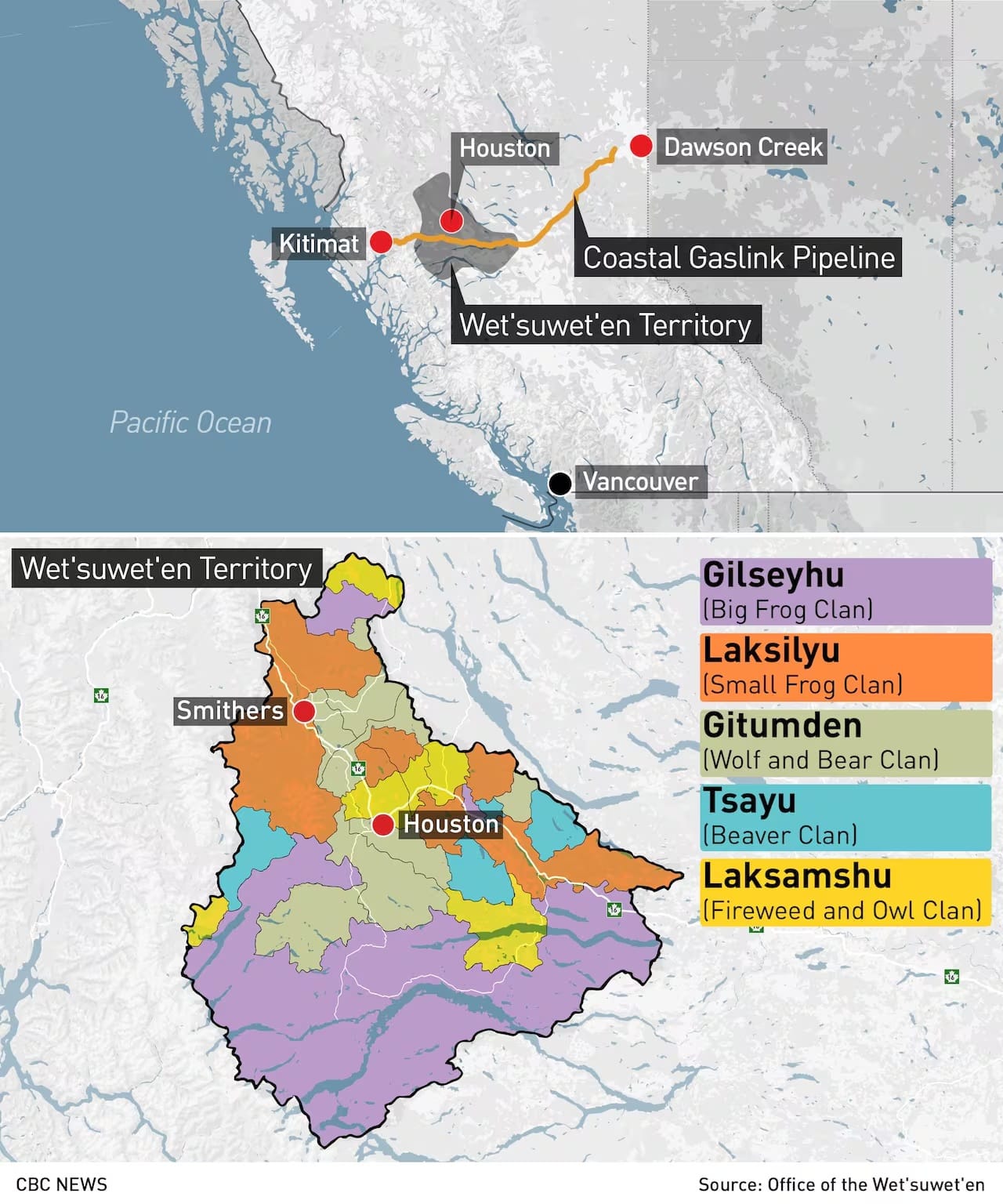
The Coastal GasLink pipeline crosses the territory of 20 First Nations. By December 2019, CGL had signed agreements with all 20 of the First Nation Governments, with 16 having signed options deals to acquire a 10% stake in the pipeline.
At this point, the reader may be confused. If all the Nations approved the pipeline through their territory and 16 even purchased a future ownership stake, how could this one pipeline snowball into a national crisis? The answer is found in First Nation governance.
In 1876, the newly formed Dominion of Canada drafted a bill called the Indian Act. The purpose of the Act was to govern the relationship between the Crown (federal and provincial governments), including Canadian citizens, and Indian Bands (recognized First Nations with treaties with the Crown). The Act codified the Indian Reserves, property rights, treaty money, and many other aspects of First Nation private life. One of the many institutions the Act imposed on First Nations was a democratic governmental system, forcing First Nations to form democratically elected band councils. The Crown determined that this would be the only form of government they would recognize.
Prior to European contact, Indigenous Peoples had many traditions for selecting their leaders. One of these historic methods was hereditary chiefs. In this system, government authority is passed down from current chiefs to their offspring. Many First Nations have mechanisms to harmonize their pre-European traditions with their colonially imposed government model. The Wet’suwet’en do not.
In 2019, the elected Wet’suwet’en band council passed a resolution to accept the agreement with Coastal GasLink. However, several of the Wet’suwet’en hereditary chiefs who still command respect in their community voiced their opposition to it. Following this internal quagmire, hereditary chiefs leveraged their community support to lead blockades of the land where the CGL pipeline would transit on their land claim and elsewhere.
Over the course of 3 months, and in response to calls from the hereditary chiefs, similar blockades have appeared across the country, severing critical rail and transit lines. These blockades have left over C$450M in freight stranded, and RBC predicts that they could shave off 0.2% of Canada's GDP growth if they continue.
Amidst this assault on critical infrastructure, what has been the government's response? At the time of writing, the federal government has taken a silk glove approach to resolving the Wet’suwet’en rail blockades. The first rail blockade went up at Tyendinaga Mohawk Territory, near Belleville, Ontario, on Feb. 6.
On Feb. 13, CN said “the orders of the court in Ontario have yet to be enforced” and began shutting down its Eastern Canadian network. It was not until Feb. 24, 18 days after the first blockade opened, that the Ontario Provincial Police enforced the order at Tyendinaga. By that time, CN had reported it would temporarily lay off about 450 workers, and VIA Rail had sent notices to close to 1,000 employees.
On March 1, the federal and provincial governments, and the hereditary chiefs released a joint statement. The joint statement includes a draft arrangement on the rights and title of Wet'suwet'en to their land claim on the CGL pipeline site. This went to the Wet'suwet'en clans for ratification, while “differences relating to the CGL project remain,” and the clans reached that arrangement in talks that ended late on Feb. 29 (five days after the OPP cleared the Tyendinaga site). Proof that enforcing court orders will not end the talks.
The lesson we hope the government learns from this ordeal (assuming it is over) is that next time a blockade defies an injunction, Ottawa must signal that it will support enforcement so law enforcement can confidently execute the order, maintaining peace and protecting Canada's critical infrastructure.
A note on terms: the Wet’suwet’en hereditary chiefs are the nation’s hereditary governance, distinct from its elected band councils. “Hereditary chiefs” below means the Wet’suwet’en hereditary chiefs unless stated otherwise.
The timeline
Dec. 31, 2019: The Supreme Court of British Columbia grants Coastal GasLink an interlocutory injunction, with an enforcement order, against obstructions on the approved build site of its natural gas pipeline in the Morice River Bridge and Morice West Forest Service Road area (Coastal GasLink Pipeline Ltd. v. Huson, 2019 BCSC 2264). The order is amended Jan. 22, 2020.
Jan. 4, 2020: The Wet’suwet’en hereditary chiefs issue Coastal GasLink an eviction notice from Wet’suwet’en territory. Coastal GasLink’s timeline of key events records the notice as issued by representatives of the Office of the Wet’suwet’en, and a Jan. 7 letter to the company confirms the Jan. 4 date.
Jan. 27: British Columbia Premier John Horgan appoints former NDP MP Nathan Cullen as provincial liaison with the Wet’suwet’en hereditary chiefs. CBC News reports his task as “de-escalating” the Coastal GasLink conflict.
Jan. 30: The hereditary chiefs agree to a seven-day period of dialogue with the province, with the RCMP standing down for the seven days. Coastal GasLink thanks the chiefs “for agreeing to this seven-day period of dialogue.”
Feb. 5: The talks are reported to have broken down the previous evening, about two days into the planned seven. Coastal GasLink’s timeline records that the Wiggus table “concludes without resolution” on Feb. 4.
Feb. 6: The RCMP begins enforcing the injunction on Wet’suwet’en territory and removing barricades; CBC News reports six arrests at an anti-pipeline camp. The same day, protesters at Tyendinaga Mohawk Territory, near Belleville, Ontario, stop trains in support of the Wet’suwet’en opponents of the pipeline.
Feb. 7: The Tyendinaga blockade halts VIA Rail passenger trains and CN freight traffic among Montreal, Ottawa, and Toronto. Protests also disrupt ports in Vancouver and Delta, British Columbia. APTN News reports a Facebook post in which a Gidimt’en clan spokesperson urges supporters to act; Canada’s National Observer quotes the call, from a video posted to Facebook, as “Shut down Canada. Do whatever you can do.”
Feb. 8: Protesters block a rail line in Toronto, temporarily disrupting Canadian Pacific Railway traffic.
Feb. 8: Members of the Kahnawà:ke Mohawk community set up a barricade on the CP rail line south of Montreal.
Feb. 10: The demonstration halts service on Exo’s Candiac commuter line in the Montreal area.
Feb. 11: A barricade near New Hazelton, British Columbia, blocks CN freight between Prince George and Prince Rupert. CBC News later identifies it as a Gitxsan solidarity action.
Feb. 12: The Manitoba government seeks an injunction to end a rail blockade near Winnipeg, and CN obtains its own court order. Trudeau urges a quick resolution and calls on demonstrators to observe the rule of law.
Feb. 13: CN announces “a disciplined and progressive shutdown of its operations in Eastern Canada” (CN release). It says blockades have ended in Manitoba and may be ending in British Columbia, but “the orders of the court in Ontario have yet to be enforced.”
Feb. 14: The Gitxsan take down their blockade near New Hazelton, on the CN line to the Port of Prince Rupert, pending a meeting, after the federal and British Columbia governments agreed to take part in talks.
Feb. 15: Indigenous Services Minister Marc Miller meets protesters at Tyendinaga Mohawk Territory. Miller says “modest progress” was made; the blockade remains.
Feb. 16: Trudeau cancels a planned trip to a gathering of Caribbean leaders in Barbados, where he had intended to promote Canada’s bid for a United Nations Security Council seat, amid the rail stoppages. Foreign Affairs Minister François-Philippe Champagne goes instead.
Feb. 17: Trudeau convenes the Incident Response Group “to address infrastructure disruptions caused by blockades across Canada.”
Feb. 18: The House of Commons holds an emergency debate on the blockades. Conservatives press the government to enforce the rule of law and end what they call illegal blockades; Liberals stress dialogue and say the government does not direct the RCMP. CN says it will temporarily lay off about 450 workers.
Feb. 19: VIA Rail says close to 1,000 employees will receive notices of temporary suspension. In west Edmonton, a court grants CN an injunction against a rail blockade, and counter-protesters tear the blockade down; it is gone later that day.
Feb. 20: Public Safety Minister Bill Blair says the RCMP has offered to move off Wet’suwet’en territory to a nearby town. British Columbia RCMP says it will leave its outpost on the territory if the road is kept clear, and Coastal GasLink says it supports the proposal to conduct policing operations from Houston, British Columbia. Wet’suwet’en hereditary chiefs travel to Ontario and Quebec to thank supporters keeping the blockades.
Feb. 21: Trudeau says: “The barricades must now come down. The injunctions must be obeyed. And the law must be upheld.” He also says: “Every attempt at dialogue has been made, but discussions have not been productive. We can’t have dialogue when only one party is coming to the table” (PMO remarks). On Montreal’s South Shore, protesters dismantle a blockade at Saint-Lambert after a police show of force. The Kahnawà:ke barricade remains.
Feb. 22: A partial rail blockade in support of the Wet’suwet’en hereditary chiefs goes up in Saskatoon. Pro-pipeline demonstrators also turn out, and a train is delayed, but trains are allowed to pass. Saskatchewan Premier Scott Moe warns that protests must remain lawful and must not disrupt transportation routes.
Feb. 23: Ontario Provincial Police give protesters at the Wyman Road site in the Tyendinaga area until midnight ET to leave or face possible criminal charges. The protesters remain at the camps.
Feb. 24: OPP officers enforce the injunction at the Tyendinaga site and arrest 10 people; CBC News reports that all 10 face charges and were released on conditions.
Feb. 26: A planned meeting between the hereditary chiefs and federal and British Columbia ministers is called off over conditions, including the governments’ wish that the chiefs encourage an end to the blockades. The chiefs say Indigenous law prevents them from directing other nations. Hours later, the chiefs call it a “miscommunication” and say the meeting is back on for Feb. 27.
Feb. 28: Talks between the hereditary chiefs and federal and British Columbia ministers resume in the Smithers area of British Columbia; CBC News describes the mood as optimistic. The chiefs had invited Horgan and Trudeau to meet them on Wet’suwet’en territory, and treat the meeting with ministers as a first step. Neither the premier nor the prime minister attends.
March 1: In a joint statement, federal and British Columbia ministers and the Wet’suwet’en hereditary chiefs say their discussions produced “a draft arrangement that will be reviewed by the Wet’suwet’en clan members through Wet’suwet’en governance protocols for ratification.” The draft arrangement, on Wet’suwet’en rights and title, was reached in talks that ended late on Feb. 29; its terms are not released. The statement adds that “differences relating to the CGL project remain.”
Sources
- Supreme Court of British Columbia (CanLII), Coastal GasLink Pipeline Ltd. v. Huson, 2019 BCSC 2264, https://www.canlii.org/en/bc/bcsc/doc/2019/2019bcsc2264/2019bcsc2264.html, Dec. 31, 2019 (reasons also hosted by Coastal GasLink: https://www.coastalgaslink.com/siteassets/pdfs/whats-new/2019/2019-12-31-coastal-gaslink-comments-on-injunction-decision/judge-church--coastal-gaslink-pipeline-ltd.-v.-huson--december-2019.pdf)
- Unist’ot’en Camp, “Wet’suwet’en Hereditary Chiefs Evict Coastal GasLink from Territory,” https://unistoten.camp/wetsuweten-hereditary-chiefs-evict-coastal-gaslink-from-territory/, Jan. 4, 2020
- CBC News, “Hereditary First Nation chiefs issue eviction notice to Coastal GasLink contractors,” https://www.cbc.ca/news/canada/calgary/wet-suwet-en-coastal-gaslink-na-moks-1.5415586, Jan. 5, 2020
- Unist’ot’en Camp, letter to Coastal GasLink, http://unistoten.camp/wp-content/uploads/2020/01/letter-to-CGL-Jan7.pdf, Jan. 7, 2020
- Coastal GasLink, “Timeline of key events,” https://www.coastalgaslink.com/siteassets/pdfs/whats-new/2020/timeline-of-key-events.pdf, February 2020
- Government of British Columbia, Office of the Premier, “Premier appoints provincial liaison with Wet’suwet’en Hereditary Chiefs,” https://news.gov.bc.ca/releases/2020PREM0018-000135, Jan. 27, 2020
- CBC News, “B.C. premier tasks former MP Nathan Cullen with ‘de-escalating’ Coastal GasLink conflict,” https://www.cbc.ca/news/indigenous/nathan-cullen-intermediary-coastal-gaslink-1.5441785, Jan. 27, 2020
- CBC News, “Talks break down between province, Wet’suwet’en hereditary chiefs over Coastal GasLink pipeline standoff,” https://www.cbc.ca/lite/story/1.5452355, Feb. 5, 2020
- The Globe and Mail, “Pipeline talks between B.C. government, Wet’suwet’en hereditary chiefs break down,” https://www.theglobeandmail.com/canada/british-columbia/article-pipeline-talks-between-bc-government-wetsuweten-hereditary-chiefs/, Feb. 5, 2020
- CBC News, “6 arrested at Wet’suwet’en anti-pipeline camp,” https://www.cbc.ca/news/canada/british-columbia/wetsuweten-arrests-coastal-gaslink-pipeline-1.5454007, Feb. 6, 2020
- CBC News, “Trains stopped in Ontario by protest in support of Wet’suwet’en pipeline opponents,” https://www.cbc.ca/news/indigenous/tyendinaga-wetsuweten-train-blockage-1.5455123, Feb. 6, 2020
- Global News, “Protesters blockade Port of Vancouver in solidarity with Wet’suwet’en,” https://globalnews.ca/news/6517946/port-of-vancouver-wetsuweten-blockade/, Feb. 6, 2020
- APTN News, “‘Shut down Canada’: Gidmit’en spokesperson calls for people to take to the streets,” https://www.aptnnews.ca/national-news/shut-down-canada-gidmiten-spokesperson-calls-for-people-to-take-to-the-streets/, Feb. 7, 2020
- CBC News, “Protesters block rail line near Dupont and Dufferin in support of Coastal GasLink pipeline opponents,” https://www.cbc.ca/news/canada/toronto/go-train-via-rail-cp-toronto-bc-pipeline-protests-1.5457179, Feb. 8, 2020
- Global News, “Protesters opposing B.C. pipeline block rail line in Toronto,” https://globalnews.ca/news/6525535/protesters-block-rail-lines-toronto/, Feb. 8, 2020
- CBC News, “Kahnawake Mohawks protest in solidarity with Wet’suwet’en Nation, blocking service on Exo’s Candiac line,” https://www.cbc.ca/news/canada/montreal/coastal-gaslink-wet-suwet-en-natural-gas-rcmp-protest-1.5457923, Feb. 10, 2020
- Global News, “Pipeline demonstration halts service on Exo’s Candiac line in Montreal,” https://globalnews.ca/news/6529697/exo-candiac-protest-wetsuweten-montreal/, Feb. 10, 2020
- Winnipeg Free Press (The Canadian Press), “Province seeks injunction to end rail protesters’ blockade,” https://www.winnipegfreepress.com/breakingnews/2020/02/12/province-seeks-injunction-to-end-rail-protesters-blockade, Feb. 12, 2020
- CBC News, “Trudeau urges quick resolution as anti-pipeline protests cripple train network,” https://www.cbc.ca/news/politics/trudeau-anti-pipeline-protests-1.5460793, Feb. 12, 2020
- CBC News, “Pallister opposes ‘2-tier law’ but feels frustration of Wet’suwet’en protesters,” https://www.cbc.ca/news/canada/manitoba/rail-blockade-injunction-protesters-wet-suwet-en-winnipeg-1.5462522, Feb. 13, 2020
- CN, “CN Initiating Progressive and Orderly Shutdown of its Eastern Canadian Network,” https://www.cn.ca/en/news/2020/02/cn-initiating-progressive-and-orderly-shutdown-of-its-eastern-ca/, Feb. 13, 2020
- Canada’s National Observer, “The Wet’suwet’en told supporters to ‘shut down Canada.’ Now trains are cancelled nationwide,” https://www.nationalobserver.com/2020/02/13/analysis/wetsuweten-told-supporters-shut-down-canada-now-trains-are-cancelled-nationwide, Feb. 13, 2020
- CBC News, “CN rail blockade in northern B.C. set to end,” https://www.cbc.ca/news/canada/british-columbia/cn-rail-blockade-in-northern-b-c-set-to-end-1.5463422, Feb. 13, 2020 (updated Feb. 14, 2020)
- Global News, “Federal and B.C. governments agree to participate in talks to end CN blockade in Northern B.C.,” https://globalnews.ca/news/6547413/federal-and-b-c-governments-agree-to-participate-in-talks-to-end-cn-blockade-in-northern-b-c/, Feb. 13, 2020
- CBC News, “Blockade continues despite ‘modest progress’ made in talks between federal minister and Tyendinaga Mohawk,” https://www.cbc.ca/news/politics/tyendinaga-mohawk-meeting-1.5465354, Feb. 15, 2020
- The Globe and Mail, “Indigenous services minister reports ‘modest progress’ with pipeline protesters as rail blockade continues,” https://www.theglobeandmail.com/canada/article-indigenous-services-minister-expects-frank-discussions-with-pipeline/, Feb. 15, 2020
- CBC News, “PM calls off diplomatic visit to Caribbean amid ongoing rail stoppages,” https://www.cbc.ca/news/politics/trudeau-cabinet-rail-blockades-1.5465966, Feb. 16, 2020
- Prime Minister’s Office, “Prime Minister Justin Trudeau convenes the Incident Response Group to address infrastructure disruptions caused by blockades across Canada,” https://www.pm.gc.ca/en/news/readouts/2020/02/17/prime-minister-justin-trudeau-convenes-incident-response-group-address, Feb. 17, 2020
- The Canadian Press (Winnipeg Free Press reprint), “A timeline on rail disruptions by anti-pipeline protesters across Canada,” https://www.winnipegfreepress.com/arts-and-life/life/greenpage/2020/02/20/a-timeline-on-rail-disruptions-by-anti-pipeline-protesters-across-canada-5, Feb. 20, 2020
- House of Commons, Debates (Hansard) No. 18, 43rd Parliament, 1st Session, https://www.ourcommons.ca/DocumentViewer/en/43-1/house/sitting-18/hansard, Feb. 18, 2020
- Global News, “Wet’suwet’en protests: House of Commons concludes emergency debate over rail blockades,” https://globalnews.ca/news/6565863/wetsuweten-protests-emergency-meeting/, Feb. 18, 2020
- Global News, “Wet’suwet’en protests: CN Rail to lay off around 450 workers amid rail blockades,” https://globalnews.ca/news/6566301/cn-rail-layoff-blockade-workers/, Feb. 18, 2020
- VIA Rail, “Temporary suspensions pending resumption of regular VIA Rail services,” https://media.viarail.ca/en/news/2020/temporary-suspensions-pending-resumption-regular-rail-services, Feb. 19, 2020
- CBC News, “Court grants CN injunction against rail blockade in west Edmonton,” https://www.cbc.ca/news/canada/edmonton/rail-blockade-wet-suwet-en-edmonton-1.5468200, Feb. 19, 2020
- Global News, “Counter-protesters tear down CN rail blockade in west Edmonton,” https://globalnews.ca/news/6568202/wetsuweten-rail-blockade-edmonton-acheson-industrial-area/, Feb. 19, 2020
- CBC News, “B.C. RCMP say they’ll leave outpost on Wet’suwet’en territory if road is kept clear,” https://www.cbc.ca/news/politics/rcmp-withdraw-bc-1.5469669, Feb. 20, 2020
- Prime Minister’s Office, “Prime Minister’s remarks for a media availability at the National Press Theatre on the blockades,” https://www.pm.gc.ca/en/news/speeches/2020/02/21/prime-ministers-remarks-media-availability-national-press-theatre, Feb. 21, 2020
- CBC News, “Protesters peacefully abandon blockade on Montreal’s South Shore,” https://www.cbc.ca/news/canada/montreal/saint-lambert-blockade-1.5470998, Feb. 21, 2020
- Global News, “Protesters dismantle camp on Montreal’s south shore after Trudeau calls for end to blockades,” https://globalnews.ca/news/6578287/protesters-dismantle-saint-lambert-camp-after-trudeau-calls-for-end-to-blockades/, Feb. 21, 2020
- CBC News, “Partial rail blockade in support of Wet’suwet’en Hereditary Chiefs erected in Saskatoon,” https://www.cbc.ca/news/canada/saskatoon/rail-blockades-go-up-in-yxe-1.5472686, Feb. 22, 2020
- Global News, “Saskatoon Wet’suwet’en solidarity, pro-pipeline demonstrators delay train,” https://globalnews.ca/news/6584635/saskatoon-wetsuweten-pro-pipeline-demonstrators-train/, Feb. 22, 2020
- CBC News, “Tyendinaga Mohawks remain at camps despite OPP warning to clear out,” https://www.cbc.ca/news/politics/tyendinaga-mohawksd-deadline-1.5473346, Feb. 23, 2020
- CBC News, “OPP arrest 10 demonstrators at Tyendinaga blockade site, charges pending,” https://www.cbc.ca/news/politics/tyendinaga-mohawks-removal-blockades-1.5473490, Feb. 24, 2020
- APTN News, “Talks between Wet’suwet’en hereditary chiefs, B.C., Canada break down before they get started,” https://www.aptnnews.ca/national-news/talks-between-wetsuweten-hereditary-chiefs-b-c-canada-break-down-before-they-get-started/, Feb. 26, 2020
- The Globe and Mail, “Planned meeting between B.C., Ottawa and Wet’suwet’en hereditary chiefs falls apart,” https://www.theglobeandmail.com/canada/article-protest-flares-up-again-along-key-eastern-ontario-rail-line-after/, Feb. 26, 2020
- Global News, “Wet’suwet’en hereditary chiefs say meeting with feds back on after ‘miscommunication’,” https://globalnews.ca/news/6599722/wetsuweten-meeting-indigenous-relations-minister-marc-miller/, Feb. 26, 2020
- CBC News, “Federal, B.C. ministers wrap talks for the day with hereditary chiefs who oppose pipeline route,” https://www.cbc.ca/news/canada/british-columbia/federal-provincial-ministers-meet-hereditary-chiefs-thursday-1.5479207, Feb. 27, 2020
- CBC News, “Mood optimistic as talks with Wet’suwet’en hereditary chiefs resume in B.C.,” https://www.cbc.ca/news/canada/british-columbia/wet-suwet-en-hereditary-chiefs-federal-provincial-ministers-meeting-coastal-gaslink-1.5479386, Feb. 28, 2020
- Government of British Columbia, “Joint statement on discussions on Wet’suwet’en rights and title,” https://news.gov.bc.ca/releases/2020IRR0005-000357, March 1, 2020
- CBC News, “Wet’suwet’en chiefs, ministers reach tentative arrangement over land title but debate over pipeline continues,” https://www.cbc.ca/news/canada/british-columbia/wetsuweten-agreement-reached-1.5481681, March 1, 2020
- The Canadian Press (Winnipeg Free Press), “Wet’suwet’en chiefs, ministers reach draft arrangement in pipeline dispute,” https://www.winnipegfreepress.com/canada/2020/03/01/newsalert-wetsuweten-chiefs-ministers-reach-proposed-agreement-in-pipeline-dispute, March 1, 2020
- The Globe and Mail, “‘Milestone’ proposed deal between Wet’suwet’en Nation, Ottawa, B.C. would recognize hereditary system,” https://www.theglobeandmail.com/canada/british-columbia/article-wetsuweten-nation-proposed-deal-land-title-coastal-gaslink-pipeline/, March 1, 2020


