
Editor's note: This In Focus feature first appeared on Feb. 28, 2020, and was updated on March 26, 2020.
In 2018, Coastal GasLink signed agreements with all 20 elected bands on its pipeline route, but tripped on a 23-year-old unresolved land claim that has triggered a national crisis. To stop this from happening again, Ottawa and Victoria should answer the question the Supreme Court left open in 1997.
2019 was not the first time the Wet’suwet’en claimed the national stage. In 1997, the Wet'suwet'en hereditary chiefs were claimants in the historic Delgamuukw v. British Columbia case. The case was a result of failed land claim negotiations between the Government of British Columbia and several Indigenous groups, including the Gitxsan and Wet’suwet’en over land which included the current site of Coastal GasLink's pipeline.
The case was important as it set the three-part test for proving Aboriginal land title:
- Pre-Sovereignty Occupation: The land must have been occupied prior to the assertion of British/Crown sovereignty (in British Columbia, generally 1846).
- Continuity: There must be a present-day connection or continuity between the modern Indigenous group and the pre-sovereignty occupants.
- Exclusivity: The group must have had an exclusive intention and ability to control the land at the time of sovereignty
Despite providing this test, the Supreme Court did not rule on the underlying land claim, kicking it back to the Province and Nations to resolve. Sadly, a resolution was never reached. Governments have left that question open ever since, and the Coastal GasLink awoke this slumbering giant.
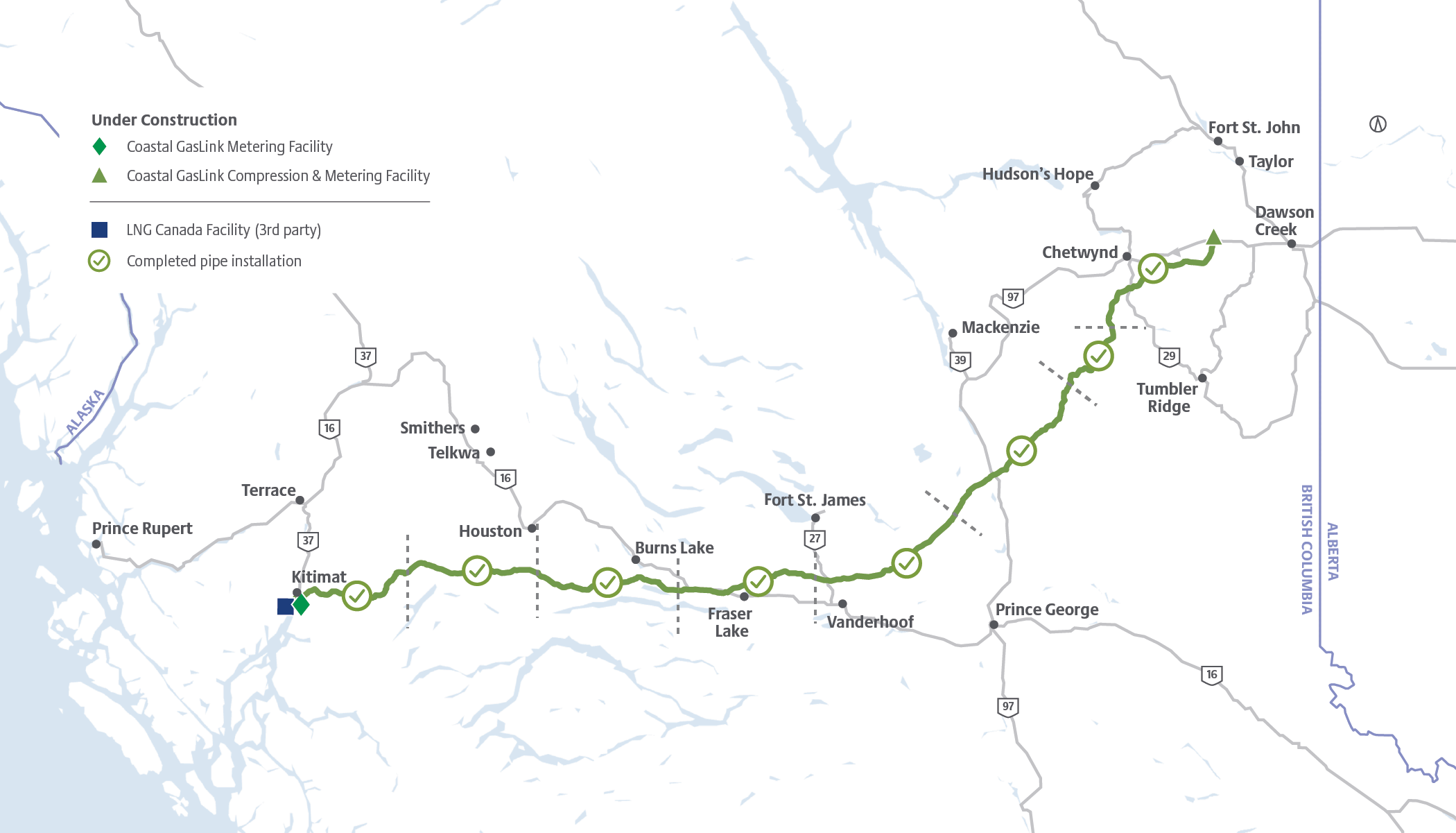
The pipeline at the centre of the dispute runs from the Montney Formation outside Dawson Creek, in northeastern British Columbia, to the LNG Canada terminal at Kitimat. On Sept. 13, 2018, Coastal GasLink announced community and project agreements with all 20 elected Indigenous bands along the route. The company said it had begun the project more than six years earlier.
So if the Wet’suwet’en First Nation signed the agreement, why are their hereditary chiefs opposing it? Wet’suwet’en hereditary chiefs hold that authority over the wider territory runs through the house and feast system, not through band councils, and they oppose the route. On Jan. 4, 2020, they issued Coastal GasLink an eviction notice from the territory, the Unist’ot’en Camp said in a statement on its own website.
From Feb. 6, 2020, when a barricade went up beside Tyendinaga Mohawk Territory near Belleville, Ontario, rail blockades in solidarity with the hereditary chiefs carried the dispute well beyond British Columbia; on Feb. 13, 2020, CN began shutting down its Eastern Canadian network.
Two authorities on one territory
The Wet’suwet’en First Nation describes the elected band council that Canada recognizes as the legitimate voice of the Wet’suwet’en people. The Wet’suwet’en Nation is the wider people, organized in clans and house groups, whose hereditary leaders’ authority is validated in the feast hall (pre-European colonization tradition), according to the Office of the Wet’suwet’en.
The two institutions draw their authority from different sources. An elected band council is chosen in band elections under the Indian Act system, while a hereditary chief’s authority comes from the house and the clan system, representing the traditional governance structure of the Wet’suwet’en people.
The land area these two groups claim differs too. The pipeline crosses traditional territory, much of it recognized as Crown land, but disputed by local Indigenous groups. The territory the Wet’suwet’en Nation claims, which the Wet’suwet’en call the Yintah, is claimed by the hereditary chiefs, not the band council, adding another layer to the complexity of this case.
How each band governs the relationship between elected council and traditional leaders is an internal decision. It is this internal unresolved governance question on top of the unresolved land claim which triggered this flash point. Agreements with band councils do not always mean all members of the band agree, a fact we are seeing play out now.
The role of the Indian Act
Parliament consolidated earlier statutes into the Indian Act in 1876, nine years after Confederation. Before then, the Crown had made many agreements with Indigenous nations, within a framework shaped by the Royal Proclamation of Oct. 7, 1763, which reserved vast unceded lands and provided that only the Crown could buy Indigenous land, by agreement.
The Act mandated the creation of elected band councils as the bodies federal governments dealt with for band business. The Act also set the terms of Indian status under federal law and pursued assimilation. An amendment of April 19, 1884 (in force Jan. 1, 1885), banned the potlatch, and amendments in 1895 extended the ban to other festivals, dances, and ceremonies. The feast is where Wet’suwet’en hereditary authority is confirmed, and from 1885 federal law banned the institution that confirms it.
The two authorities on one territory are largely a product of federal law, which means governments that treat band agreements as decisive are relying on the institution their own statute put in place.
Successive federal and provincial governments took legislative action to further assimilate Indigenous Peoples into European Canada. In 1920, Parliament amended the Indian Act to compel attendance at residential schools. The Act’s other assimilation tool was enfranchisement, under which a university degree or entry into certain professions could cost a person Indian status in exchange for Canadian citizenship rights, until the language of compulsory enfranchisement was removed in 1961.
Status is a separate question from citizenship and the vote. First Nations people are Canadian citizens, yet until 1960 status Indians generally could not vote in federal elections without giving up status through enfranchisement, and amendments to the Canada Elections Act on March 31, 1960, gave them the federal vote without that condition.
We mention this to provide context. Indigenous governance is a complex set of institutions that have been coloured by nearly 300 years of history and colonization. The question of who holds legitimate authority within a band is an internal question to that band. Barring the repealing of the Indian Act, elected band councils will continue to exist. How they integrate traditional governance structures that have been severely disrupted over the past centuries remains an issue that will externalize conflict until clear divisions in authority are made.
Unceded, and unsettled
Wet’suwet’en territory is unceded: no historic treaty with the Crown covers it, and there is no Wet’suwet’en treaty land.
The modern route has not closed the gap. The Wet’suwet’en entered the British Columbia treaty process and reached Stage 4, and no treaty has followed.
With no treaty, no declaration, and no retrial, the Crown is a party to both the courtroom route and the negotiating route, and whoever is to blame for each stall, it has carried neither to a conclusion. That leaves governments relying on the absence of an answer, which is the gap Coastal GasLink’s band agreements have been asked to fill.
The injunction and the rail lines
On Dec. 31, 2019, the Supreme Court of British Columbia granted Coastal GasLink an injunction (2019 BCSC 2264), and the RCMP has enforced it.
Slowly, the government and police forces are enforcing similar injunctions to dismantle sympathy blockades across the country. If current trends continue, construction on the Coastal GasLink pipeline will continue, and the rest of Canada will cease to be disrupted by sympathy protests.
The case for the band agreements
Band agreements already carry democratic weight. Elected band councils answer to their members at the ballot box, and they are the bodies Canadian governments deal with; every one of the 20 along the route signed an agreement to permit and benefit from the pipeline construction. Letting leaders who do not stand for election override them inverts democratic accountability and gives a veto to whoever claims authority over the wider territory. No court has declared title in favour of the hereditary chiefs, and until one does, the land is administered as Crown land. The injunction governs, and Coastal GasLink, which secured agreements with every elected band, should be allowed to build.
The councils’ mandate is real, and it is a mandate under the Indian Act system for band affairs. Title under Delgamuukw belongs to the Aboriginal group, and the group’s claim was brought by its hereditary chiefs on behalf of their houses.
Uncertainty over title raises the risk on every project on the territory, for investors and for the bands that signed as well as for the Wet’suwet’en.
What should change
Ottawa and Victoria should treat title on Wet’suwet’en territory as a question to settle. That means a negotiation with the title claimants that has a defined end, or a return to court on the Delgamuukw test.
The Wet’suwet’en should decide who speaks for title, through their own governance. If authority over the territory rests with the houses or with elected councils, Crown agreements should align and respect the line.
Governments and proponents should also stop presenting band agreements as the last word on territory that band councils do not govern. Coastal GasLink’s agreements are real and they matter, and they should be described as what they are: the consent of the elected councils over disputed lands.
The injunction should be obeyed while it stands, and the blockades should end. The rule of law binds protesters to obey court orders, and it binds the Crown to resolve the claims it has left open.
Sources
- Supreme Court of Canada, Delgamuukw v. British Columbia, [1997] 3 S.C.R. 1010, https://decisions.scc-csc.ca/scc-csc/scc-csc/en/1569/1/document.do, Dec. 11, 1997
- CanLII, Delgamuukw v. British Columbia, 1997 CanLII 302 (SCC), https://www.canlii.org/en/ca/scc/doc/1997/1997canlii302/1997canlii302.html, Dec. 11, 1997
- CanLII, Tsilhqot’in Nation v. British Columbia, 2014 SCC 44, https://www.canlii.org/en/ca/scc/doc/2014/2014scc44/2014scc44.html, June 26, 2014
- CanLII, Supreme Court of British Columbia, Coastal GasLink injunction ruling, 2019 BCSC 2264, https://www.canlii.org/en/bc/bcsc/doc/2019/2019bcsc2264/2019bcsc2264.html, Dec. 31, 2019
- TC Energy (TransCanada), “Coastal GasLink signs agreements with 100 per cent of B.C. elected Indigenous bands along the pipeline route,” https://www.tcenergy.com/announcements/2018/2018-09-13coastal-gaslink-signs-agreements-with-100-per-cent-of-b.c.-elected-indigenous-bands-along-the-pipeline-route, Sept. 13, 2018
- Unist’ot’en Camp, “Wet’suwet’en Hereditary Chiefs Evict Coastal GasLink from Territory” (the camp’s own statement), https://unistoten.camp/wetsuweten-hereditary-chiefs-evict-coastal-gaslink-from-territory/, Jan. 4, 2020
- Unist’ot’en Camp, letter to Coastal GasLink referring to the eviction notice delivered Jan. 4, 2020, http://unistoten.camp/wp-content/uploads/2020/01/letter-to-CGL-Jan7.pdf, Jan. 7, 2020
- CBC News, “Trains stopped in Ontario by protest in support of Wet’suwet’en pipeline opponents,” https://www.cbc.ca/news/indigenous/tyendinaga-wetsuweten-train-blockage-1.5455123, Feb. 6, 2020
- CN, “CN Initiating Progressive and Orderly Shutdown of its Eastern Canadian Network,” https://www.cn.ca/en/news/2020/02/cn-initiating-progressive-and-orderly-shutdown-of-its-eastern-ca/, Feb. 13, 2020
- Office of the Wet’suwet’en, “Governance,” https://wetsuweten.ca/index.php?page=governance, accessed Oct. 5, 2026
- BC Treaty Commission, “Wet’suwet’en Hereditary Chiefs,” https://bctreaty.ca/wetsuweten-hereditary-chiefs/, current page
- Truth and Reconciliation Commission of Canada, “Canada’s Residential Schools: The History, Part 1, Origins to 1939” (Final Report, Volume 1), https://nctr.ca/wp-content/uploads/2021/01/Volume_1_History_Part_1_English_Web.pdf, 2015
- Truth and Reconciliation Commission of Canada, “Canada’s Residential Schools: The History, Part 2, 1939 to 2000” (Final Report, Volume 1), https://nctr.ca/wp-content/uploads/2021/01/Volume_1_History_Part_2_English_Web.pdf, 2015
- Library and Archives Canada, Department of Indian Affairs, “Annual Report for the Year Ended March 31, 1920” (Sessional Paper No. 27, 1921), https://data2.archives.ca/obj/020010/f2/1920-IAAR-RAAI.pdf, 1921
- Avalon Project, Yale Law School, “The Royal Proclamation – October 7, 1763,” https://avalon.law.yale.edu/18th_century/proc1763.asp, Oct. 7, 1763
- Elections Canada Civic Education, “First Nations Peoples and the Right to Vote Case Study,” https://electionsanddemocracy.ca/voting-rights-through-time-0/first-nations-and-right-vote-case-study, accessed Oct. 5, 2026
- The Canadian Encyclopedia, “Indian Act,” https://thecanadianencyclopedia.ca/en/article/indian-act, last edited Sept. 23, 2022
- The Canadian Encyclopedia, “Potlatch Ban,” https://thecanadianencyclopedia.ca/en/article/potlatch-ban, published June 12, 2023
- The Canadian Encyclopedia, “Indigenous Suffrage,” https://thecanadianencyclopedia.ca/en/article/indigenous-suffrage, accessed Oct. 5, 2026


